Home
Videos
Steve McCurry – Profile
Resource Center: Non-Photographic Diversions
Outreach Program
Natalie Fobes – Profile
Nacho Corbella Video Page
Media Archive
Foundry 2011 – Buenos Aires
LEARN
SEE
NETWORK
REFERENCE
NAV MENU
Organization
Legacy
FOUNDRY
PWAU
Outreach
Interviews
Ideas around images
HOME
About Us
Outreach Program
Videos
Resource Center
Search for:
Search Button
Home
»
»
Smita Sharma
Smita Sharma
←
Return to People Index
PhotoWings Media Archive
Share
Featured
1:15:19
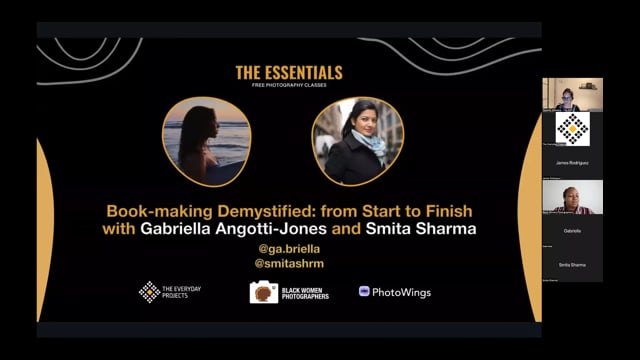
The Essentials Season 3: “Book-making Demystified: from Start to Finish” with Gabriella Angotti-Jones and Smita Sharma
Smita Sharma
Documentary Photographer
Projects · appears in 4
Foundry Photojournalism Workshop
Collection
The VII Foundation
Collection
The Everyday Projects
Collection
The Essentials
Collection
Tags
Concepts
Perspective
6
Resilience
6
Storytelling
6
Context
5
Trust
5
Collaboration
4
Inspiration
4
Legacy
4
Reflection
4
Self-Discovery
4
Topics
Health & Medicine
5
Human Rights
5
South Asia
5
War Photography
5
Career Development
4
Documentary Photography
4
Photojournalism
4
Social Media & Photography
4
Education & Youth
3
Visual Narrative
3
Climate Crisis & Environment
2
Consent & Access
2
Emerging Photographers
2
Human Rights Photography
2
India
2
Kolkata
2
Long-form Photography
2
Mentorship & Education
2
Multimedia & Transmedia
2
New York
2
Oceania & Pacific
2
Photo Books & Publications
2
Photo Education Programs
2
Photo Research & Access
2
Photographer Interview
2
Photographer Safety & Security
2
Photography Awards
2
Photography Education
2
Photography Workshop
2
Picture Editing
2
Poverty & Economic Inequality
2
Racial Justice & Anti-Racism
2
Sub-Saharan Africa
2
Afghanistan
1
Africa
1
AI in Photography
1
Associated Press & Wire Services
1
Collaborative & Community Photography
1
Community Photography
1
Democracy & Politics
1
Environmental Photography
1
Gabriella Angotti
1
Gender & Sexuality
1
Grant Writing & Funding
1
Indigenous Rights & Representation
1
Iraq & Middle East
1
Latin America
1
Lighting Techniques
1
Mexico
1
Myanmar & Southeast Asia
1
North America
1
PTSD & Mental Health
1
Representation & Diversity
1
Science & Nature Photography
1
Smita Sharma Evening Presentation
1
Ukraine
1
War & Conflict Photography
1
+47 more
Portfolio
6 videos · every appearance
1:15:19
The Essentials Season 3: “Book-making Demystified: from Start to Finish” with Gabriella Angotti-Jones and Smita Sharma
Decorated photographers Gabriella Angotti-Jones and Smita Sharma, who’ve recently traversed the world of book-making, will demystify this process from start to finish. In this class, they’ll answer oft-asked questions, such as: When is the right time to make a book? How do you put together a book proposal? How do you find the right publisher, designer, editor, etc.? How do you fund and market a book? By setting long-term goals for your work, Gabriella and Smita reveal how this milestone in a photographer’s career is both possible and accessible. Gabriella Angotti-Jones is a documentary photographer based in Los Angeles, California. Gabriella uses her editorial background to inform her imagery, focusing on found light, intimate storytelling moments, and graphic compositions. Her documentary work focuses on the intersection of race, identity, and environmental justice. She was previously a staff photographer at the LA Times, and has worked at papers across the country, including the San Francisco Chronicle, Tampa Bay Times, the Las Vegas Review-Journal, and The New York Times. Follow Gabriella, also a member of Black Women Photographers, on Instagram at @ga.briella. Smita Sharma is a Delhi-based photojournalist who has documented gender issues, sexual crimes, and human trafficking in the Global South through long-form visual narratives. She is a TED fellow and an IWMF reporting fellow. Smita is committed to representing people with dignity, and her visceral images have been published in a range of outlets, including the New York Times, BBC World, Wall Street Journal, TIME, and National Geographic Magazine. Her work has also been exhibited and shown globally, including at the UN Headquarters in New York. She is the recipient of awards from Amnesty International, the Las Fotos Project, One World Media, and the Fetisov Journalism Award. Follow Smita, co-founder of @EverydaySoutheastAsia, on Instagram at @smitashrm.
PhotoWings
1:25:35
Telling Stories with Impact: Smita Sharma
Smita Sharma is an award-winning photojournalist based in Delhi. Her work focuses on gender issues, sexual crimes, and human trafficking. In some parts of the world, girls are as likely to be married off or trafficked as they are to be educated. Sharma thoughtfully depicts overlooked girls and young women, while making sure not to disrupt the lives of her subjects in the process. She is committed to representing people with dignity and telling underrepresented stories with impact. Join us for a presentation where Sharma will talk about how and why she created the series Left Behind, Not My Shame and We Cry In Silence. Her presentation will be followed by a Q&A session.
PhotoWings
48:49
Present Your Work - Public Speaking Tips from Smita Sharma
Standing out in photography takes more than great images—it requires the ability to share your work effectively. Knowing how to present your work can open doors to commissions, publications, and meaningful connections. Join award-winning photojournalist Smita Sharma for an inspiring webinar. A TED Fellow, TED Speaker, and IWMF Reporting Fellow, Smita will share practical tips to help you present your work and improve your public speaking skills. Learn how to create impactful presentations and tell your story in a way that resonates. Join us on January 23 at 12:00 EST / 18:00 CET for her presentation, followed by a Q&A session. A recording of this conversation will be available in our Video Collection shortly after the event.
PhotoWings
27:47
Smita Sharma: We Cry In Silence
PhotoWings
1:14
Smita Sharma | Advice for Young Photographers
At the 2018 Foundry Photojournalism Workshop in Kolkata, India, we spoke with award-winning photojournalist Smita Sharma. In this video, Sharma discusses the importance of deep and thorough research to any successful photojournalism project. Smita Sharma is an award-winning photojournalist and visual storyteller based in Delhi, India, reporting on critical human rights and social issues in her own community as well as in the Global South on assignments for Human Rights Watch, National Geographic Magazine, and other publications. From documenting the effect of pregnancy on girl’s education in Kenya to child marriage in Nepal, and sex-trafficking across India and Bangladesh, Sharma is committed to representing people with dignity and telling underrepresented stories with impact. Sharma is an IWMF Reporting Fellow and a TED Fellow. Her work has been exhibited and shown globally including at the UN Headquarters in New York. Smita is a member of Women Photograph and Diversify Photo and has taken HEFAT training in Mexico City organised by IWMF. She is a graduate from the photojournalism and documentary photography program of International Center of Photography, New York and has a post graduate diploma in Journalism from University of Pune. In 2016, Smita organised a bicycle campaign along with non-profit PVCHR in Varanasi and donated bicycles to abuse survivors who were assaulted on their commute to school. The campaign was a way to de-stigmatise and reintegrate the girls in their communities and help them to continue their education. At the 2018 Foundry Photojournalism Workshop in Kolkata, India, we spoke with award-winning photojournalist Smita Sharma. In this video, Sharma discusses the importance of deep and thorough research to any successful photojournalism project.
PhotoWings
24:03
Smita Sharma Evening Presentation – Foundry Photojournalism Workshop 2018
Smita Sharma is an independent photojournalist based in Delhi and Kolkata. Her work primarily focusses on gender, health, social and human rights issues. Her work has been published in various international publications including The Washington Post, The New York Times, BBC World, TIME Lightbox, The Globe and Mail, Spiegel, Channel 4, Caravan Magazine, Newsweek, Human Rights Watch among others. Her work has been screened and exhibited in various countries including USA, India, Cambodia, Myanmar, South Korea, France, UK and Saudi Arabia. Her long term project Not My Shame on sexual violence and rape in India was shown during CSW-59 and CSW-61 (Commission on the Status of Women) at the UN Headquarters in New York. She is the recipient of The Washington Post Award at the Eddie Adams Workshop in 2013, National Silver and PVCHR Bronze medal for Protection of Human Rights at Rex Conclave, Delhi in 2015. She was given Indian Of The Year award in 2017, for her contribution in the field of journalism by Brands Academy, Delhi. In 2018, she was given Exceptional Women of Excellence award by Women Economic Forum, Delhi. In 2016, Smita organised a bicycle campaign along with non-profit PVCHR in Varanasi and donated bicycles to abuse survivors who were assaulted on their commute to school. The campaign was a way to de-stigmatise and reintegrate the girls in their communities and help them to continue their education. Since 2016, Smita has been working on a project on human trafficking in South Asia where she is documenting the flesh trade, domestic servitude, bride trafficking and how it operates in the region. Smita graduated in photojournalism and documentary photography from the International Center of Photography, New York in 2013 and has a post graduate diploma in Journalism from University of Pune. Born and raised in Shillong, India, she has lived and travelled for work in South Asia, Africa, Latin America and USA.
PhotoWings
No videos match your search.
Foundry Photojournalism Workshop
Collection · Related
6:36
Jason Eskenazi - Storytelling and Visual Literacy
Photographer Jason Eskenazi, a Fulbright Scholar and Guggenheim Fellow, discusses storytelling and visual literacy through the extraordinary photographs he took for his book, Wonderland (which won the prestigious Pictures of the Year International Book Award in 2008). Jason illustrates what he calls the visual grammar of photography, which includes composition, light, perspective, and context, and how he strives to work within that grammar to capture images with an emotional resonance. See more interviews with Foundry Workshop Instructors: https://photowings.org/foundry-photojournalism-workshop/ The fall of the Berlin Wall led Eskenazi out of Queens into the larger world. After trips to Germany and Romania for their first democratic elections he traveled to Russia in 1991, just before the August coup that marked the end of the USSR, and has returned many times since culminating in a photography book project called Wonderland: A Fairy Tale of the Soviet Monolith, winner of Best Photography Book 2008 by Pictures of the Year International. In 2004 he received a Fulbright Scholarship to return to Russia to make a series of large format color portraits called Title Nation with a Russian colleague which will be published Fall 2010. Jason Eskenazi has received numerous awards including a Guggenheim Fellowship, 1999; The Dorothea Lange/Paul Taylor Prize, 1999, for his work in a Jewish Village in Azerbaijan; and The Alicia Patterson Foundation Grant, 1996. His work has appeared in many magazines including Time, Newsweek and The New York Times and Soros Foundation publications. http://www.jasoneskenazi.com/ PhotoWings' mission is to highlight and help facilitate the power of photography to influence the world. We help photography to be better understood, created, utilized, seen, and saved.
Foundry Photojournalism Workshop
22:11
Rodrigo Cruz: Mining in Peru - Foundry Photojournalism Workshop 2017
Foundry Photojournalism Workshop
17:49
Ron Haviv: My World of Motion - Foundry Photojournalism Workshop 2017
Foundry Photojournalism Workshop
54:17
Photo Stories from the Square Mile Initiative
This series showcases recent work from members of VII Community, in partnership with PhotoWings. Every few months, VII Insider invites photographers from VII Community to present their stories. In this episode, we look at three photographers whose work is featured in “Square Mile” at the Photoville Festival. VII Community provides ongoing education and support to a network of VII Academy alumni and Foundry Photojournalism Workshop participants. VII Community is a program of The VII Foundation in partnership with PhotoWings. Square Mile is an initiative that presents diverse photographic explorations by members of VII Community. It is a geographic framework, signifying a local focus on spaces where personal, local, and global influences intersect. The projects explore how themes such as climate change, identity, history, legacy, migration, gender, and environment appear within a local perspective. We are delighted to be joined by Peruvian photographer Alejandra Orosco, who presents her project “ Only Memories Do Not Drown”, highlighting the 1978 story of El Peñol, a town whose residents were compelled to relocate because of a hydroelectric project that would eventually supply 30% of Colombia’s population with energy. Doug Barrett is an American photographer who will discuss his series “Riley’s Cancel Journey.” Seven-year-old Riley Simmons faced WilmsTumor, a rare form of kidney cancer. Doug documented the emotions that Riley and her family experienced as they began their courageous battle for survival. Nepalese photographer Uma Bista showcases “ Stay Home, Sisters,” a personal project that addresses taboos surrounding menstruation. During ‘Chhaupadi,’ each month, women in Western Nepal are subjected to a ritual of isolation. Deemed impure, they are forced to stay in cowsheds. The event will be moderated by VII contributing photographer Espen Rasmussen.
Foundry Photojournalism Workshop
1:07:56
Photo Stories Documenting Abuse
This series showcases recent work from members of VII Community, in partnership with PhotoWings. Every few months, VII Insider invites photographers from VII Community to present their stories. In this episode, we look at three photography projects that documenting human rights violations. VII Community provides ongoing education and support to a network of VII Academy alumni and Foundry Photojournalism Workshop participants. VII Community is a program of The VII Foundation in partnership with PhotoWings. We are delighted to be joined by Ecuadorian photographer David Diaz Arcos, who presents his project “Bird’s Nest” telling the stories of young adolescent women who are survivors of sexual exploitation in Ecuador. Italian photographer Viviana Peretti, currently based in Colombia, discusses her series “Searching for Lost Lives” sharing a light on the people who forcibly disappeared in Colombia. Iranian photographer Shirin Abedi, who grew up and lives in Hanover, shows “Invisible Students” which investigates the long-term effects of school bullying in Germany. The event is moderated by The VII Foundation contributing photographer Anush Babajanyan.
Foundry Photojournalism Workshop
49:22
Photo Stories from the Square Mile Initiative
This series showcases recent work from members of VII Community. Every few months, we invite photographers from VII Community to present their stories. In this episode, we look at three photographers whose work is featured in “Square Mile” at the PhotoVogue Festival. VII Community provides ongoing education and support to a network of The VII Foundation’s alumni and Foundry Photojournalism Workshop participants, numbering more than 1200 professionals. Square Mile is an initiative that presents diverse photographic explorations by members of VII Community. It is a geographic framework, signifying a local focus on spaces where personal, local, and global influences intersect. The projects explore how themes such as climate change, identity, history, legacy, migration, gender, and environment appear within a local perspective. The upcoming edition of Square Mile, curated especially for the PhotoVogue festival, offers an insight into the work of twelve photographers. They show humanity’s multifaceted connection to the natural world, explore the resilience of communities deeply rooted in their land, and pay respect to ancestral traditions. They tell a story about nature’s guardians, who are protecting the environment and creatures that populate it, and examine the intricate relations between humans and all living. We are delighted to be joined by American photographer Jordan Gale, who presents “You Will Never Want for Anything.” His project explores the Klamath River, the site of the world’s largest dam removal project, and in doing so, examines the history of exploitation and resource extraction. Chinky Shukla is an Indian photographer who will discuss “When Buddha Stopped Smiling.”. Her project tells the stories of the desert communities of Pokhran. When India announced its nuclear capability in 1974, the explosions echoed across the world — but in that thunderous moment, local voices were silenced. Mexican photographer Sara Escobar showcases “Burrolandia: The Donkey Obsession,” a story about a donkey sanctuary led by German Flores. As mechanization has replaced working animals, Mexico’s donkey population has plummeted. At this shelter in Otumba, caregivers work to provide dignified lives for Mexican donkeys while preserving their legacy. The event will be moderated by VII contributing photographer Anush Babajanyan.
Foundry Photojournalism Workshop
1:20
Ron Haviv: The business of preserving a legacy, Foundry Photojournalism Workshop 2011
Foundry Photojournalism Workshop
10:03
Marko Drobnjakovic - Foundry 2023 Presentation
Foundry Photojournalism Workshop
See more ▾
The VII Foundation
Collection · Related
1:26:12
The Camera at War: 170 Years of Weaponizing Photography, with Hilary Roberts
All forms of visual media are vulnerable to being manipulated or ‘weaponized’ in the context of modern conflict. However, the consequences of manipulating photographs are potentially far-reaching and long-term. In recent years, advances in digital technology have led many to question whether photographs of war and conflict can ever be trusted. The conflicts in Ukraine and the Middle East, as well as other world events, have lent urgency to this debate. Drawing on an incredible range of imagery from the Imperial War Museum’s vast collection and other major archives around the globe, expert curator Hilary Roberts presents a new perspective on the role of image manipulation in this field over the past 170 years, exploring the consequences for our understanding of historic and contemporary conflicts. Join Ron Haviv in conversation with Hilary Roberts as they discuss the complicated relationship between conflict photography and the ‘truth’. The discussion will explore the application and legacy of photomanipulation techniques in conflict photography and the myriad ways in which layers of meaning can be added, erased, or changed completely.
The VII Foundation
1:14:10
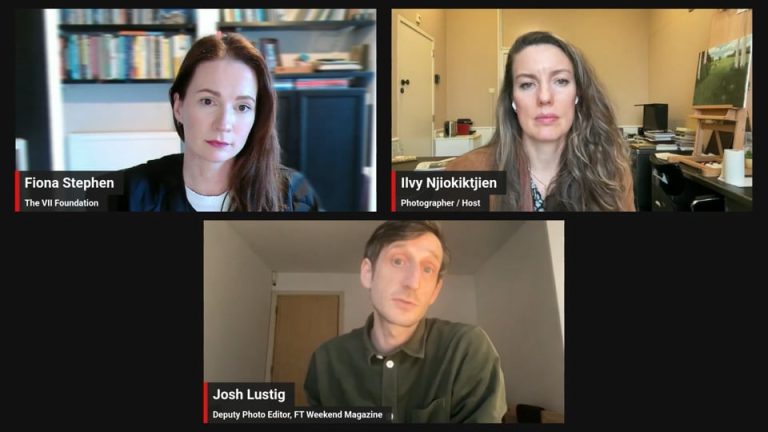
Photo Editors Series - Josh Lustig
The Photo Editors Series is a series of conversations with well-known photo editors about how they view the media today, the role of visuals in reporting, the work they like to see, and advice for photographers on how best to connect with publishers. The series combines an overview of the contemporary media landscape with practical tips. The editors speak as individuals rather than representatives of their organizations, and the event is interactive and offers good opportunities for audience questions. In this seventeenth episode, Ilvy Njiokiktjien and Fiona Stephen speak with Josh Lustig, deputy photo editor of the Financial Times Weekend Magazine. Josh writes regularly on photography for the magazine, is a frequent participant at festivals and workshops, and has been a visiting lecturer at several universities including, London College of Communication, University of Syracuse, NY, USA and the School of Media and Journalism, Aarhus, Denmark.
The VII Foundation
2:22:03
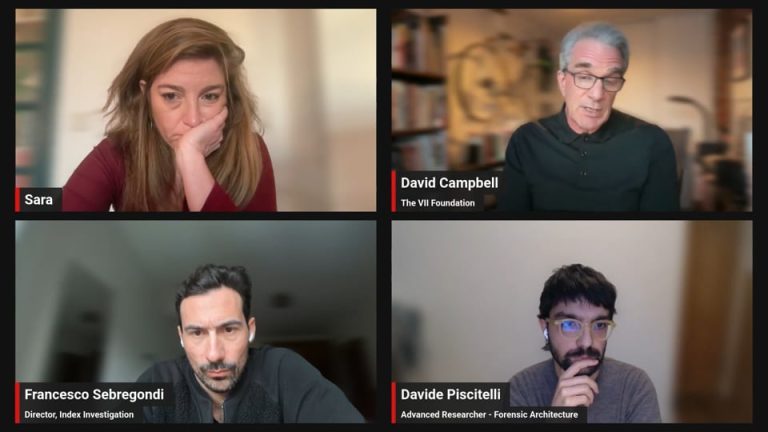
Open-Source Intelligence - An Investigative Journalism Workshop
Open-source intelligence (OSINT), publicly available data sources used in the verification of information and events, is integral to the work of many investigative journalists. Increasingly hostile or inaccessible reporting environments, and the weaponisation of disinformation, have intensified the need for verifiable source information to ensure the authenticity and integrity of independent reporting. In this special extended online event, we examine the application of open-source intelligence strategies within media and justice contexts. This two-hour workshop will introduce a range of practical OSINT tools, consider accessibility and online safety, and examine case studies, including long-term operations within closed states and recent high-profile events across the U.S. and Europe, where OSINT tools have enabled critical forensic analysis and reporting. Join David Campbell in discussion with a panel of expert guests; Documentary filmmaker and investigative journalist, Sara Creta, whose research focuses on the intersection of emerging technology and human rights; Davide Piscitelli, Advanced Researcher at Forensic Architecture, a research agency based at Goldsmiths, University of London; and Francesco Sebregondi, architect and researcher specialising in digital investigation, particularly the use of visual and spatial analysis to document violence and human rights violations.
The VII Foundation
1:12:20
Photo Editors Series – Gabriel Eisenmeier
The Photo Editors Series are conversations with well-known photo editors about how they view the media today, the role of visuals in reporting, the work they like to see, and advice for photographers on how best to connect with publishers. Hosted by David Campbell and Ilvy Njiokiktjien, the series combines an overview of the contemporary media landscape with practical tips. The editors in the series speak as individuals rather than representatives of their organizations. In this tenth episode, we are speaking with Gabriel Eisenmeier of de Volkskrant, a daily newspaper in The Netherlands.
The VII Foundation
1:00:57
A Presentation of Ed Kashi & Julie Winokur’s film, Sheila and Joe
In this special presentation, Ed Kashi and Julie Winokur introduce their short film “Sheila and Joe,” followed by a question and answer. with the filmmakers and subjects. “Sheila and Joe” is a love story that unfolds behind bars. This story is told through hundreds of letters shared by Sheila Rule, a former New York Timescorrespondent, and Joe Robinson, a man serving a prison sentence of 25 years to life. Despite a 20 year age difference, and undeterred by the physical barriers of prison, their love has unstoppable momentum. Intimate and nuanced, this short film visits the space between compassion and passion, revealing a man who transcends his crime and a woman who dares to break the rules. In the process, they shine a light on the practice of mass incarceration in the US. “Sheila & Joe” premiered at the Woodstock Film Festival in 2021 and received Second Place for Documentary Daily Life from Pictures of the Year International 2020. The film was published on NPR’s The Picture Show in 2021.
The VII Foundation
54:20
Arturo Soto – The Psycho-Geography of a British City
How can photography challenge stereotypes of a well-known city? Is it possible to picture the politics of a place? What are the costs and benefits of asking these questions from the position of the outsider? In this event, Mexican-born photographer Arturo Soto discusses these themes in his work about the British university city of Oxford following the controversial “Brexit” referendum that led to the UK leaving the European Union. Soto’s work has been published in his book “A Certain Logic of Expectations”, which is described as proposing a counter-narrative of Oxford. Drawing on psycho-geography, and using an interplay of words and text, the work reflects on the contested relationship between visual representation and the history and myths of a particular location.
The VII Foundation
54:26
Book Club – Ed Kashi, The Cali Years
The Cali Years is a 25-year collection of Ed Kashi’s archive from 1979-2004, from his time spent living in California. This significant period marked the development of a college graduate into a renowned visual storyteller. This motley collection of images contains everything from family life to celebrities, from magazine assignments to in-depth personal projects. What was originally intended to be a small zine became a fold-out hand-bound collectible book. This collaborative project made in Ed’s studio with Brenda Bingham and Michael Curry will be produced in a limited edition of 100. In this event – hosted by Ziyah Gafic – Ed, Brenda, and Michael discuss the purpose and production of this book.
The VII Foundation
45:35
Kris Graves – 1492/1619 American Aftermaths
This event is a conversation between 2021 Aftermath Project grant winner Kris Graves and Aftermath Project founder, and VII photographer, Sara Terry. Their talk focuses on Kris’ grant-winning project, Privileged Mediocrity and the Deceived Within. Kris shows images he made during his grant year, as he explores systematic unfairness in America – and talks with Sara about his critique of the ways racism, capitalism and power have shaped the U.S. They both share ideas about what goes into writing an American Aftermath grant proposal, and the kinds of projects that might be a good fit for the grant. Sara talks about the judging process and what judges look for.
The VII Foundation
See more ▾
The Everyday Projects
Collection · Related
47:18
“Then & Now: Photographers Repicturing Their Archive in 2020” presented with Everyday Projects, HuffPost, and RYOT
THEN & NOW: PHOTOGRAPHERS REPICTURING THEIR ARCHIVE IN 2020 presented with Everyday Projects, HuffPost, and RYOT Featuring Sheila Pree Bright, Yolanda Escobar Jiménez, Brian Otieno, Xiaojie Ouyang, and moderated by Christy Havranek and Elie Gardner Photoville 2020 Talks On-demand recordings are made possible in partnership with PhotoWIngs with additional support by the Philip and Edith Leonian Foundation This year–amidst the compounded pandemics of COVID-19 and systemic racism, amidst global social upheaval–thirteen photographers returned to places and moments they have photographed before, to make new images and record the visual impact of 2020. Their photographs reveal evolutions in our interactions and traditions, how we use (or have stopped using) public spaces, inequality and unrest, economic strain, and demands for justice. Photographers Sheila Pree Bright (Atlanta, U.S.A.), Yolanda Escobar Jiménez (Quito, Ecuador), Brian Otieno (Nairobi, Kenya), and Xiaojie Ouyang (Wuhan, China), discuss what it was like to return to places they had photographed before and make new photographs. Moderated by Christy Havranek of HuffPost, and Elie Gardner of The Everyday Projects, they will discuss their findings, their photographs, why they chose those specific places, and what their photographs may tell us as we collectively look for a roadmap to our futures. photoville.nyc/online/then-now-photographers-repicturing-their-archive-2020/
The Everyday Projects
1:36:08
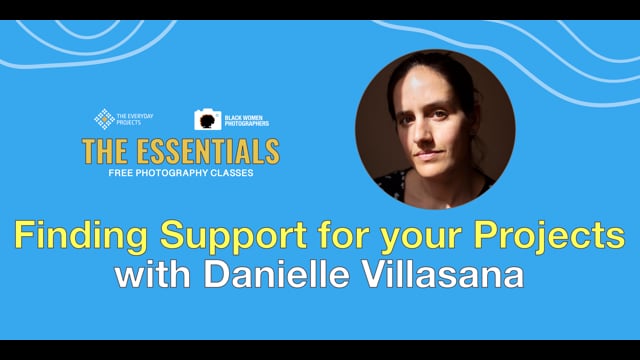
The Essentials: Finding Project Support with Danielle Villasana
Danielle Villasana will share tips on preparing grant applications for new or ongoing projects. She’ll cover the do’s and don'ts as well as various funding organizations within the visual media industry. This video is part of The Essentials, a series of online classes presented by The Everyday Projects and Black Women Photographers. You can find the whole series here: everydayprojects.org/webinars
The Everyday Projects
1:13:45
The Essentials: Building a Narrative with Kiana Hayeri
Kiana Hayeri is known for her visual storytelling that is intimate, personal, and lyrical. In this class, she will discuss how to build a narrative from start to finish, including how to pitch a story to an editor and how to break down a story while photographing on assignment. This video is part of The Essentials, a series of online classes presented by The Everyday Projects and Black Women Photographers. You can find the whole series here: everydayprojects.org/webinars
The Everyday Projects
1:23:58
The Essentials: Honing Your Skills with Nicky Woo
Nicky Quamina-Woo has a career as both a commercial and documentary photographer. In this class, she will touch on the basics of portraiture lighting, marketing your work, and tailoring your portfolio to fit the client. She reviews the portfolio of three students for the class to learn from, and shows examples of successful images, investigating why each works (or doesn’t) from a lighting perspective. This video is part of The Essentials, a series of online classes presented by The Everyday Projects and Black Women Photographers. You can find the whole series here: everydayprojects.org/webinars
The Everyday Projects
1:23:23
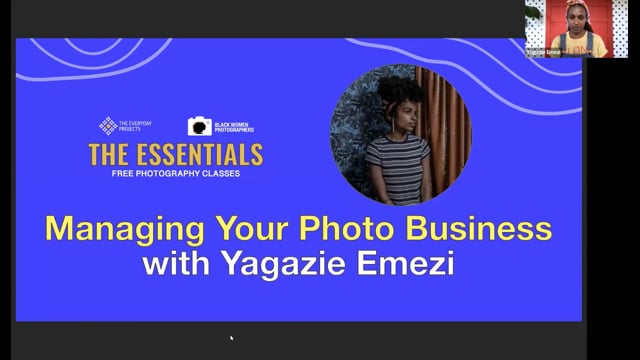
The Essentials: Be Your Own Manager with Yagazie Emezi
Yagazie Emezi will draw from her personal experiences of utilizing social media for self-promotion, managing finances as a freelancer, understanding contracts, and finding opportunities. She will speak to the challenges photographers regularly face, including setting a day rate and understanding usage and copyrights. Her session will be rooted in practical tools and strategies, and in understanding the overall value of one’s work. Yagazie Emezi is a Nigerian artist and self-taught photojournalist focused on stories surrounding African women and their health, sexuality, education and human rights. Having worked extensively across Africa, Yagazie also covers stories on identity and culture, social justice, climate change and migration. Her art practice uses photography and sculpture to construct visual critiques of Nigeria's socio-political state and the roles media play in it, pulling from history and current events. You can follow her @yagazieemezi.
The Everyday Projects
1:33:03
“Demystifying Digital Security: Practical Guidance for Journalists” with Ela Stapley
From surveillance to identity theft, journalists face a range of digital security threats as they go about their work. Knowing what steps to take to better protect themselves and their sources is more and more important. From secure communications to protecting online data, this session will teach journalists practical tips that they can use to increase their security. If you have doubts about WhatsApp security or have ever wondered if it is safe to store your passwords in your browser, then this session is for you! Ela Stapley is a digital safety expert and trainer working with journalists around the world to help them be safer both when online and when using technology. She is part of the Emergencies team at the Committee to Protect Journalists where she supports journalists on a wide range of issues ranging from device security to online harassment. Ela also leads the online harassment initiative at the International Women's Media Foundation where she works with journalists and other organisations to find solutions to violence online. Ela is a former freelance journalist and holds an MA in International Journalism from Cardiff University, UK.
The Everyday Projects
1:24:07
“Building Your Career” with Sarahbeth Maney and Sarah Waiswa
Careers in photography have no roadmap, and a common question is, how do I get started? How do I make my first contacts in the industry, get my first assignment, work on my first projects? Photographers Sarahbeth Maney and Sarah Waiswa will use their own passion projects and reporting projects to walk you through the start of their careers and highlight some of their most important learnings along the way. Coming from different points of their career and different backgrounds, Sarabeth and Sarah will showcase what they were able to do with limited support and discuss what it was truly like to get their careers off the ground. Sarahbeth Maney is a 2021-22 photography fellow at The New York Times' Washington bureau. Her personal work focuses on topics related to housing insecurity, disability, and inequalities that disproportionately impact Black and brown communities. Most recently, she has documented immigration along the U.S.-Mexico border, the Black Lives Matter movement, and the California wildfire season. In addition, she filmed a short documentary following Ahmet Ustunel, the first blind person to kayak independently from Asia to Europe using navigational prototype technology. Maney graduated from San Francisco State University in 2019 with a degree in photojournalism and has interned at the San Francisco Chronicle and The Flint Journal in Michigan. She is a recipient of the inaugural Pulitzer Center and Diversify Photo Eyewitness Photojournalism Grant in 2020. Her photography has been published by TIME, Vanity Fair, Apple, The Washington Post, and the San Francisco Chronicle, among others. Maney is a member of Diversify Photo, the National Association of Black Journalists, Authority Collective, and Black Women Photographers. You can follow her @sbmaneyphoto. Sarah Waiswa is Ugandan-born, Kenya-based documentary and portrait photographer with an interest in exploring the New African Identity on the continent. With degrees in sociology and psychology, Sarah’s work explores social issues in Africa in a contemporary and non-traditional way. In 2015, she was awarded first place in the story and creative categories in the Uganda Press Photo Awards and second place in the Daily Life and portrait categories. In 2016 she was awarded the Discovery Award in Arles, France and in 2017 she was awarded the Gerald Kraak Award in Johannesburg, South Africa. In 2018, she was named a Canon Brand Ambassador and was selected for the World Press Photo 6x6 Africa Program. She is a Pulitzer Center Rainforest Journalism Fund grantee. Her work has been exhibited around the world, most recently at the National Gallery of Victoria in Australia. Her work is currently on display at the Bristol Photo Festival 2021 in collaboration with the Bristol Archives. Her photographs have been published in the Washington Post, Bloomberg, the New York Times, among other publications, and she has worked with brands such as Christian Dior and Chloe. Earlier this year, she founded African Women in Photography, a non profit organization dedicated to elevating and celebrating the work of women and non binary photographers from Africa. She is a contributing photographer to Everyday Africa. You can follow her @lafrohemien.
The Everyday Projects
1:30:37
“So You Got An Assignment – Now What? Working with Photo Editors” with Jehan Jillani and Olivier Laurent
When on an assignment, knowing what an editor expects of you can be challenging, especially early on in your career. Photo editors Olivier Laurent (The Washington Post) and Jehan Jillani (The Atlantic) will take a practical approach to explaining the barebones of how to make photojournalism a sustainable career, and will delve into strategies on how to work with photo editors, how to make sure your voice is heard, and how to turn in photos with the proper information. Jehan Jillani is a Visuals Editor at The Atlantic where she commissions photography and illustrations for the publication’s digital features and special projects. She was previously the lead Picture and Visuals editor at the Guardian US. Jehan has also worked as a photo editor at National Geographic and The New Yorker. Her work has been recognized by the Society of Publication Designers and American Photography, and she has spoken about photography at numerous educational institutions. Jehan is a graduate of Smith College and is based in Brooklyn, NY. You can follow her @jehanjillani. Olivier Laurent is a foreign photo editor at The Washington Post, with a specific focus on Africa, Asia and the Middle-East. He also edits the Climate & Environment section, assigning photographers to cover the climate emergency. In 2019, he was part of the climate team that won the Pulitzer Prize in Explanatory Reporting for a series that "showed with scientific clarity the dire effects of extreme temperatures on the planet." In 2018, he coordinated the newspaper's visual coverage of the humanitarian crisis in Yemen, working with Lorenzo Tugnoli, a contract photographer with the Post. The photo essay won the 2019 Pulitzer Prize in Feature Photography. You can follow him @olivierclaurent.
The Everyday Projects
See more ▾
The Essentials
Collection · Related
1:36:08
The Essentials: Finding Project Support with Danielle Villasana
Danielle Villasana will share tips on preparing grant applications for new or ongoing projects. She’ll cover the do’s and don'ts as well as various funding organizations within the visual media industry. This video is part of The Essentials, a series of online classes presented by The Everyday Projects and Black Women Photographers. You can find the whole series here: everydayprojects.org/webinars
The Essentials
1:13:45
The Essentials: Building a Narrative with Kiana Hayeri
Kiana Hayeri is known for her visual storytelling that is intimate, personal, and lyrical. In this class, she will discuss how to build a narrative from start to finish, including how to pitch a story to an editor and how to break down a story while photographing on assignment. This video is part of The Essentials, a series of online classes presented by The Everyday Projects and Black Women Photographers. You can find the whole series here: everydayprojects.org/webinars
The Essentials
1:23:58
The Essentials: Honing Your Skills with Nicky Woo
Nicky Quamina-Woo has a career as both a commercial and documentary photographer. In this class, she will touch on the basics of portraiture lighting, marketing your work, and tailoring your portfolio to fit the client. She reviews the portfolio of three students for the class to learn from, and shows examples of successful images, investigating why each works (or doesn’t) from a lighting perspective. This video is part of The Essentials, a series of online classes presented by The Everyday Projects and Black Women Photographers. You can find the whole series here: everydayprojects.org/webinars
The Essentials
1:23:23
The Essentials: Be Your Own Manager with Yagazie Emezi
Yagazie Emezi will draw from her personal experiences of utilizing social media for self-promotion, managing finances as a freelancer, understanding contracts, and finding opportunities. She will speak to the challenges photographers regularly face, including setting a day rate and understanding usage and copyrights. Her session will be rooted in practical tools and strategies, and in understanding the overall value of one’s work. Yagazie Emezi is a Nigerian artist and self-taught photojournalist focused on stories surrounding African women and their health, sexuality, education and human rights. Having worked extensively across Africa, Yagazie also covers stories on identity and culture, social justice, climate change and migration. Her art practice uses photography and sculpture to construct visual critiques of Nigeria's socio-political state and the roles media play in it, pulling from history and current events. You can follow her @yagazieemezi.
The Essentials
1:24:07
“Building Your Career” with Sarahbeth Maney and Sarah Waiswa
Careers in photography have no roadmap, and a common question is, how do I get started? How do I make my first contacts in the industry, get my first assignment, work on my first projects? Photographers Sarahbeth Maney and Sarah Waiswa will use their own passion projects and reporting projects to walk you through the start of their careers and highlight some of their most important learnings along the way. Coming from different points of their career and different backgrounds, Sarabeth and Sarah will showcase what they were able to do with limited support and discuss what it was truly like to get their careers off the ground. Sarahbeth Maney is a 2021-22 photography fellow at The New York Times' Washington bureau. Her personal work focuses on topics related to housing insecurity, disability, and inequalities that disproportionately impact Black and brown communities. Most recently, she has documented immigration along the U.S.-Mexico border, the Black Lives Matter movement, and the California wildfire season. In addition, she filmed a short documentary following Ahmet Ustunel, the first blind person to kayak independently from Asia to Europe using navigational prototype technology. Maney graduated from San Francisco State University in 2019 with a degree in photojournalism and has interned at the San Francisco Chronicle and The Flint Journal in Michigan. She is a recipient of the inaugural Pulitzer Center and Diversify Photo Eyewitness Photojournalism Grant in 2020. Her photography has been published by TIME, Vanity Fair, Apple, The Washington Post, and the San Francisco Chronicle, among others. Maney is a member of Diversify Photo, the National Association of Black Journalists, Authority Collective, and Black Women Photographers. You can follow her @sbmaneyphoto. Sarah Waiswa is Ugandan-born, Kenya-based documentary and portrait photographer with an interest in exploring the New African Identity on the continent. With degrees in sociology and psychology, Sarah’s work explores social issues in Africa in a contemporary and non-traditional way. In 2015, she was awarded first place in the story and creative categories in the Uganda Press Photo Awards and second place in the Daily Life and portrait categories. In 2016 she was awarded the Discovery Award in Arles, France and in 2017 she was awarded the Gerald Kraak Award in Johannesburg, South Africa. In 2018, she was named a Canon Brand Ambassador and was selected for the World Press Photo 6x6 Africa Program. She is a Pulitzer Center Rainforest Journalism Fund grantee. Her work has been exhibited around the world, most recently at the National Gallery of Victoria in Australia. Her work is currently on display at the Bristol Photo Festival 2021 in collaboration with the Bristol Archives. Her photographs have been published in the Washington Post, Bloomberg, the New York Times, among other publications, and she has worked with brands such as Christian Dior and Chloe. Earlier this year, she founded African Women in Photography, a non profit organization dedicated to elevating and celebrating the work of women and non binary photographers from Africa. She is a contributing photographer to Everyday Africa. You can follow her @lafrohemien.
The Essentials
1:22:50
The Essentials: Expanding Your Vision with Yagazie Emezi
In this class, Yagazie Emezi will guide us through her personal projects and finding her own creative voice in photography. As she guides us through this aspect of her career, she will talk about the process of learning to trust her own vision, what others can learn from her journey, and how she then applies her personal style to assignment work. This class builds on Yagazie’s previous class in The Essentials, “Be Your Own Manager". Yagazie Emezi is a Nigerian artist and self-taught photojournalist focused on stories surrounding African women and their health, sexuality, education and human rights. Having worked extensively across Africa, Yagazie also covers stories on identity and culture, social justice, climate change and migration. Her art practice uses photography and sculpture to construct visual critiques of Nigeria's socio-political state and the roles media play in it, pulling from history and current events. You can follow her @yagazieemezi.
The Essentials
1:21:57
The Essentials Season 3: “SO YOU GOT AN ASSIGNMENT, NOW WHAT: THE PHOTOGRAPHER’S PERSPECTIVE” WITH ANNIE FLANAGAN
You’ve put in all the work to pitch, make connections with editors, and you’ve landed a commission. Now what? A prolific photographer with ample assignment experience, Annie Flanagan will share their know-how on what to do in preparation for the assignment (both logistically and photographically), how to communicate with editors, and stay safe in the field. They’ll also talk about the crucial side of assignment work that’s not brought to light enough: rates, budgeting, expenses, and contracts. And, Annie will give tips on how to maintain relationships with editors even after the assignment is over. Annie Flanagan is a photographer based in New Orleans, Louisiana. Their photographs are rooted in the documentary tradition, frequently exploring themes of gender, memory, and people’s relationship to place. Their select clients include The New York Times, National Geographic, The Guardian, ESPN, and The Players’ Tribune. Annie holds a Master of Science from Syracuse University S.I. Newhouse School of Public Communications. Follow Annie on Instagram at @annieflanagan.
The Essentials
1:31:31
The Essentials Season 3: “DO NO HARM: ETHICS” WITH CHERISS MAY
In this session, prominent photographer and adjunct professor at Howard University Cheriss May explores one of the most—if not the most—important aspects of making honest and compelling work: ethics. She’ll teach about the many layers of consent, avoiding stereotypical or sensationalistic approaches, establishing trust with people you photograph, and how to control the use of your images and how to have those conversations with editors. Cheriss will also showcase examples of social impact through photography and walking the line between activism and photojournalism. Cheriss May is a lauded portrait photographer and adjunct professor at her alma mater, Howard University. Her passion radiates through her aptitude to connect to the soul of those she photographs. Cheriss’s work centers on the intersectionality of race, culture, and politics—from the White House to Capitol Hill, and everyday life in communities across the country. She is a frequent contributor to The New York Times and has been published in O Magazine, The White House website, People, ABC News, The Today Show, among other publications. Her work is featured in the permanent collection of the African American Museum in Philadelphia, PA, and the Schomburg Center for Research in Black Culture in Harlem, NY. Originally from Kansas City, MO, Cheriss is based in Washington, D.C., and is a member of Black Women Photographers. Follow Cheriss on Instagram at @cherissmay.
The Essentials
See more ▾
Legal
Privacy Policy
/
Terms of Use
Home
✕
✕
All
Resource Center
✕
✕
✕