Home
Videos
Steve McCurry – Profile
Resource Center: Non-Photographic Diversions
Outreach Program
Natalie Fobes – Profile
Nacho Corbella Video Page
Media Archive
Foundry 2011 – Buenos Aires
LEARN
SEE
NETWORK
REFERENCE
NAV MENU
Organization
Legacy
FOUNDRY
PWAU
Outreach
Interviews
Ideas around images
HOME
About Us
Outreach Program
Videos
Resource Center
Search for:
Search Button
Home
»
»
Paul Lowe
Paul Lowe
←
Return to People Index
PhotoWings Media Archive
Share
Featured
1:11:45
Reporting the Siege of Sarajevo
Paul Lowe
Projects · appears in 1
The VII Foundation
Collection
Tags
Concepts
Legacy
15
Context
14
Perspective
14
Resilience
14
Trust
14
Collaboration
13
Inspiration
13
Storytelling
13
Self-Discovery
12
Reflection
11
Topics
Education & Youth
12
Social Media & Photography
12
Climate Crisis & Environment
11
Health & Medicine
11
Archiving & Preservation
10
War Photography
10
Documentary Photography
8
Photojournalism
8
Representation & Diversity
8
Visual Heritage & Memory
8
Bosnia & Balkans
7
Human Rights
7
Indigenous Rights & Representation
7
Migration & Refugees
7
Photography Education
7
South Asia
7
Sub-Saharan Africa
7
Career Development
6
Democracy & Politics
6
Mentorship & Education
6
Photo Archive
6
Science & Nature Photography
6
Syria
6
Caption Writing
5
Environmental Photography
5
Family Albums & Vernacular Photography
5
Myanmar & Southeast Asia
5
Oceania & Pacific
5
Photo Research & Access
5
Photographer Safety & Security
5
War & Conflict Photography
5
Conflict Photography
4
Content Authenticity & Verification
4
North America
4
Poverty & Economic Inequality
4
Ukraine
4
Visual Literacy
4
Visual Narrative
4
Alison Nordstr
3
Animal Rights & Conservation
3
Consent & Access
3
Fine Art Photography
3
Iraq & Middle East
3
Latin America
3
Long-form Photography
3
Nature Photography
3
Photographer Interview
3
Sarajevo
3
Street Photography
3
Collaborative & Community Photography
2
Community Photography
2
Ecuador & Biodiversity
2
Human Rights Photography
2
Mobile Photography
2
Multimedia & Transmedia
2
Photo Business & Licensing
2
Photography & Social Change
2
Sudan & South Sudan
2
Aerial & Drone Photography
1
AI in Photography
1
Arctic & Polar
1
Collaboration & Partnership
1
Digital Revolution
1
Gaza & Palestine
1
Haiti
1
Landscape Photography
1
Photo Education Programs
1
Photo Festivals & Events
1
Photography Awards
1
Photography Ethics
1
Post-Processing
1
PTSD & Mental Health
1
Wildlife Photography
1
+63 more
Portfolio
17 videos · every appearance
1:11:45
Reporting the Siege of Sarajevo
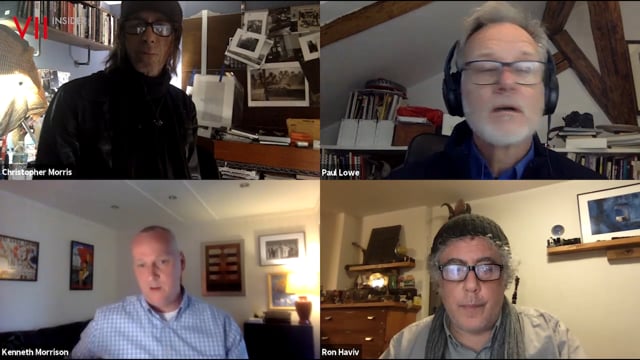
The Siege of Sarajevo remains the longest siege in modern European history, lasting three times longer than the Battle of Stalingrad and over a year longer than the Siege of Leningrad. Reporting the Siege of Sarajevo provides the first detailed account of the reporting of this siege and the role that journalists played in highlighting both military and non-military aspects of it. The book draws on detailed primary and secondary material in English and Bosnian, as well as extensive interviews with international correspondents who covered events in Sarajevo from within siege lines. It also includes hitherto unpublished images taken by the co-author and award-winning photojournalist Paul Lowe. In this VII Insider talk, Lowe and co-author Kenneth Morrison discuss the book in conversation with VII photographers and co-founders who covered the siege — Ron Haviv and Christopher Morris. They overview the scope and structure of the book, the process of putting it together, their experiences covering the historic event, and the siege’s importance to the history of the journalism profession. Dr. Paul Lowe is a Reader in Documentary Photography and the Course Leader of the Masters program in Photojournalism and Documentary Photography at the London College of Communication, University of the Arts, London, UK. Paul is an award-winning photographer who has been published in TIME, Newsweek, Life, The Sunday Times Magazine, The Observer, and The Independent, amongst others. He has covered breaking news the world over, including the fall of the Berlin Wall, Nelson Mandela’s release, famine in Africa, the conflict in the former Yugoslavia, and the destruction of Grozny. Kenneth Morrison is Professor of Modern Southeast European History at De Montfort University, UK. He has written extensively on the modern history of the Western Balkans and is the author of Nationalism, Statehood and Identity in Post-Yugoslav Montenegro (2018), Sarajevo’s Holiday Inn: On the Frontline of Politics and War (2016), Montenegro: A Modern History (2009), and the co-author of Reporting the Siege of Sarajevo (2021) and The Sandžak: A History (2013). Kenneth was a Visiting Professor at the London School of Economics and Political Science in 2018 and has previously acted as Specialist Adviser on Western Balkan politics for the UK House of Lords International Relations Select Committee. He is currently writing a book focusing on the utility of hotels in urban conflicts. Ron Haviv is an Emmy nominated and award-winning photojournalist and co-founder of the VII Agency, dedicated to documenting conflict and raising awareness about human rights issues around the globe. His first photography book, Blood and Honey: A Balkan War Journal, was called “One of the best non-fiction books of the year,” by The Los Angeles Times and “A chilling but vastly important record of a people’s suffering,” by Newsweek. His other monographs are Afghanistan: The Road to Kabul, Haiti: 12 January 2010, and The Lost Rolls. Haviv has produced an unflinching record of the injustices of war. His work in the Balkans, which spanned over a decade of conflict, was used as evidence to indict and convict war criminals at the International Criminal Tribunal for the former Yugoslavia in The Hague. President George H.W. Bush cited Haviv’s chilling photographs documenting paramilitary violence in Panama as one of the reasons for the 1989 American intervention. Haviv is the central character in six documentary films, including National Geographic Explorer’s Freelance in a World of Risk and River of Gold. He has provided expert analysis and commentary on ABC News, BBC, CNN, NPR, MSNBC, NBC Nightly News, Good Morning America, and The Charlie Rose Show. Haviv is a founding member of VII Agency based in New York. Christopher Morris was born in California in 1958 and began his career as a documentary conflict photographer working almost exclusively for TIME Magazine, where he has been on contract since 1990. He has been credited with redefining political coverage in America during his years working at the White House for TIME Magazine from 2000 till 2009. Simultaneously to his career as a photojournalist, Morris has expanded his work into the fashion world. He has received various awards, including the Robert Capa Gold Medal, the Olivier Rebbot Award, the Journalism Award from the Overseas Press Club, two Infinity Awards for photojournalism from the International Center of Photography in New York, the PDN Look Fashion Editorial Award and numerous World Press Photo awards. Morris is a founding member of VII Agency based in New York.
PhotoWings
1:06:09
Creating Impact New Visual Perspectives on the Climate Crisis
This symposium explores three urgent questions about creating impactful communications on the climate crisis, in advance of the UN Climate Change Conference 2021 (COP26) to be held in Glasgow, Scotland starting 1 November 2021: How can visual images and stories impact the climate crisis agenda? Are there new global voices and perspectives emerging? How can images improve public engagement ahead of COP26? Hosted by VII Insider, the symposium is a collaboration between Climate Visuals, University of the Arts London’s Photography and Arts Research Centre, Slideluck Editorial and The VII Foundation. VII Insider events are made possible by the generous support of PhotoWings. This hour-long event, held on 30 June 2021, also introduced the Climate Visuals programme, its evidence base and previewed submissions to ‘Visualizing Climate Change: An Open Call for Photography’, which is a partnership with TED Countdown. Moderator: Paul Lowe Participants and Agenda: Toby Smith, Climate Visuals Introduction to Climate Visuals, its evidence base on impact, and the concept behind the ‘Visualizing Climate Change’ initiative Maria Teresa Salvati, Slideluck Editorial A personal selection from the Open Call highlighting new voices and perspectives on climate change Nichole Sobecki, VII Recent photographic work on the climate crisis Moderated Q&A
PhotoWings
1:07:25
Visualizing the Environmental Emergency: Towards Trans-Disciplinarity
Addressing contemporary climate and environmental crises requires the collaboration of artists, scientists, and other experts to respond to the challenges we are facing. The integration of these different groups is necessary to act as buffers between the public and scientific data and to encourage a richer and more complex conversation about the fundamental issues driving the climate and environmental crises and how to use the powerful impact of contemporary art and photography. In this context, trans-disciplinarity, which integrates the natural, social and health sciences in a humanities context that transcends the traditional boundaries of discipline, is the path to follow. Trans-disciplinarity involves the integration of knowledge and the abandonment of binary thinking, so we can help construct deeper meanings in the context of real-world problems. For example, when dealing with environmental issues, we know we need to refer to a complexity that embraces a world of injustice and inequality, both in the causes and the consequences of the problems. How can contemporary photography and art raise their ambition to make real changes in the world? What artistic, human, or scientific approach does trans-disciplinary work require artists to put in place? How do they maintain their personal vision when they deal with scientific data? This event features Maria Teresa Salvati and guest speaker David Cross and is moderated by Dr. Paul Lowe. This event is supported by the Photography and the Archive Research Centre, London College of Communication, University of the Arts London, and Everything is Connected.
PhotoWings
1:15:53
Visualizing the Climate Crisis Representing Ocean Acidification
In the visualization of the climate crisis, how can ocean acidification be represented? Ocean acidification is a change to the ocean’s chemistry produced by rising levels of carbon dioxide (CO2). The ocean absorbs about 30 percent of the CO2 that human activity releases into the atmosphere, and as levels of atmospheric CO2 increase, so do the levels in the ocean. When CO2 is absorbed by seawater, a series of chemical reactions occur that damage structures such as sea shells and coral skeletons. This harms calcifying organisms such as oysters, clams, sea urchins, shallow-water corals, deep-sea corals, and calcareous plankton. When these organisms are at risk, the entire food web may also be at risk. How can this phenomenon be visualized? How can visual storytellers work with scientists and develop a narrative that shows the problem and points the way toward solutions? What messages can have a tangible impact on a local and global level? How can we communicate the connection between issues in the Atlantic Ocean, the corals in the Philippines? and life and habits in Europe? To address these issues, Katherine Jack (photographer) and Octavio Aburto (research scientist) will be in conversation with Maria Teresa Salvati (founder and director of Everything is Connected). The talk will be moderated by Paul Lowe (Reader in Documentary Photography at UAL, London). This event is the first in a new series, Visualizing the Climate Crisis, which explores the potential and the role that contemporary photography, together with different disciplines, can have in addressing the multi-layered theme of climate change. The series will feature visual journalists doing evidence-based, research-informed, image-led reporting on climate issues. They will be in conversation with other professionals representing a diverse range of disciplines, such as science, policy-making, education, architecture, social innovation, media, and more. The starting point for each event is a specific topic for which two professionals will explore the possibility of thinking beyond photography in a genuinely trans-disciplinary approach to expand reach, involve the wider public, and move people from being inspired to taking action. This series is organized by Everything is Connected, UAL, University of the Arts London, and VII Insider.
PhotoWings
1:07:20
Visualizing the Climate Crisis - Virtual Water
This is the second talk of the series, Visualizing the Climate Crisis, which explores the potential and the role that contemporary photography, together with different disciplines, can have in addressing the multi-layered theme of climate change. The series will feature visual journalists doing evidence-based, research-informed, image-led reporting on climate issues. They will be in conversation with other professionals representing a diverse range of disciplines, such as science, policy-making, education, architecture, social innovation, media, and more, trying to explore the possibility of thinking beyond photography in a genuinely trans-disciplinary approach to expand reach, involve the wider public, and move people from being inspired to taking action. This event features Uwe H. Martin and Dr. Francesca Greco in conversation with Maria Teresa Salvati, moderated by Dr. Paul Lowe. Virtual water–also known as embodied or hidden water–is a term coined by John Anthony Allan in 1993. The concept refers to the quantity of freshwater used in the products, services, and processes people buy and use daily. Virtual water often goes unseen by the end-user of a product or service, but that water has been consumed throughout the value chain, which makes the creation of that product or service possible. The concept of virtual water trade was introduced to refer to the idea that countries can save domestic water by importing food. How can ‘virtual water’ be visualized? Can visual storytellers and scientists collaborate to communicate the whole story to the wide public? How could we make people aware of their eating and buying habits, be conscious of their choices, and eventually reduce their footprint on the planet?
PhotoWings
1:12:59
Visualizing the Climate Crisis - The Fashion System
“Calculating, industrial society is obliged to form consumers who don’t calculate; if clothing’s producers and consumers had the same consciousness, clothing would be bought (and produced) only at the very slow rate of its dilapidation” – Roland Barthes, The Fashion System, 1983. The United Nations reports the fashion industry is the second most polluting of all industries, resulting in 8% of all carbon emissions and 20% of all global wastewater. The system is also responsible for perpetuating an economic paradigm leading to social and climate injustice at the cost of poorer workers, animals, and the planet. Who could lead the systemic changes that the fashion industry requires in order to go beyond “greenwashing” and be more sustainable? How could we–media, policymakers, artists, activists, designers, institutions, and educators–help re-wire a system that is so interconnected and unjust? What could be the best way to talk to people and change the fashion system? This is the third talk of the series, Visualizing the Climate Crisis, which explores the potential and the role that contemporary photography, together with different disciplines, can have in addressing the multi-layered theme of climate change. The series features visual journalists doing evidence-based, research-informed, image-led reporting on climate issues. They will be in conversation with other professionals representing a diverse range of disciplines, such as science, policy-making, education, architecture, social innovation, media, and more, trying to explore the possibility of thinking beyond photography in a genuinely trans-disciplinary approach to expand reach, involve the wider public, and move people from being inspired to taking action. In this event, Rebecca Cappelli (filmmaker and activist) and Sara Sozzani Maino (Creative Director and educator) are in conversation with Maria Teresa Salvati. The event will be moderated by Dr. Paul Lowe.
PhotoWings
1:16:28
Visualizing the Climate Crisis: Deforestation
Deforestation refers to the decrease in forest areas across the world. Forests are lost to make space for agriculture and animal grazing and to obtain wood for fuel, manufacturing, and construction. Greatly accelerated by human activities since 1960, deforestation has been negatively affecting natural ecosystems, biodiversity, and the climate. The UN’s Food and Agriculture Organization estimates the annual rate of deforestation to be around 1.3 million km2 per decade. How can ‘deforestation’ be visualized? Can visual storytellers, social innovators, and artistic directors work together to tell the whole story and the connectedness of all, to the wide public? How can we make people aware that their living and cultural habits have an impact on the forests, and consequently the loss of biodiversity? How do we show the impact of deforestation on the climate, which has side effects on our lives too? This is the fourth talk of the series, Visualizing the Climate Crisis, which explores the potential and the role that contemporary photography, together with different disciplines, can have in addressing the multi-layered theme of climate change. The series features visual journalists doing evidence-based, research-informed, image-led reporting on climate issues. They will be in conversation with other professionals representing a diverse range of disciplines, such as science, policy-making, education, architecture, social innovation, media, and more, trying to explore the possibility of thinking beyond photography in a genuinely trans-disciplinary approach to expand reach, involve the wider public, and move people from being inspired to taking action. In this event, Raphael Alves (documentary photographer) and Louise Fedotov-Clements (artistic director), are in conversation with Maria Teresa Salvati. The event will be moderated by Dr. Paul Lowe.
PhotoWings
1:08:09
Visualizing the Climate Crisis: Climate Migration
Over 370 million people worldwide have been forcibly displaced by floods, windstorms, earthquakes, or droughts since 2008, with a record 32 million in 2022 alone. Climate change is driving extreme weather events and their consequences, leading to a rise in the number of climate refugees. In the worst-case scenario, 1.2 billion people could be displaced by 2050 due to natural disasters and other ecological threats, according to The Institute for Economics and Peace. National and international responses to this challenge remain limited, and protection for those affected is inadequate, despite some steps in the right direction. Most importantly, there is no clear definition of a climate refugee, nor are climate refugees covered by the 1951 Refugee Convention. This means that climate cannot currently be cited as a reason for seeking asylum or refugee status. How can climate migration be visualized? How can we shift perception about this phenomenon? Can visual stories and data visualization work together to tell the whole story to the public? This is the fifth talk of the series Visualizing the Climate Crisis, which explores the potential and role that contemporary photography, together with other disciplines, can have in addressing the multi-layered theme of climate change. The series features visual journalists doing evidence-based, research-informed, image-led reporting on climate issues. They will be in conversation with other professionals representing a diverse range of disciplines, such as science, policy-making, education, architecture, social innovation, media, and more, trying to explore the possibility of thinking beyond photography in a genuinely trans-disciplinary approach to expand reach, involve the wider public, and move people from being inspired to taking action. In this event, Alessio Paduano (documentary photographer) and Federica Fragapane (Information Designer) are in conversation with Maria Teresa Salvati (founder and director of Everything is Connected), moderated by Paul Lowe (Professor of Conflict, Peace and the Image at London College of Communication, University of the Arts London). This series is organized by Everything is Connected; UAL, University of the Arts London; and VII Insider.
PhotoWings
1:16:25
Bosnia 30 years later - Lessons from reporting the Bosnian War
On 6 April 1992, as part of the collapse of the former Yugoslavia, Serbian forces attacked the Bosnian capital of Sarajevo, setting off a three-year war marked by ethnic cleansing and genocide. The Bosnian War – which killed 100,000 civilians and soliders, displaced more than two million people, and saw tens of thousands of women raped – was long regarded, until the Russian invasion of Ukraine, as Europe’s deadliest conflict since World War II. NATO airstrikes at the end of August 1995 – after the Srebrenica genocide and prompted by the shelling of the Sarajevo marketplace that month – forced Republika Srpska forces to retreat and led to negotiations that produced the Dayton Peace Agreement in December 1995. Based on ethnic divisions and secured by the international community, the Dayton agreement has resulted in a three-decades-long fragile peace. In this event, VII photographers who covered the Bosnian War will review how they reported the conflict – with an emphasis on the civilian experience – and reflect on both what was and was not photographed, as well as the impact their images had (or did not have). The discussion will also focus on what lessons can be learned from the Bosnian experience for visual journalists working in conflict zones today. Featuring The Estate of Alexandra Boulat, Ziyah Gafic, Ron Haviv, and Paul Lowe.
PhotoWings
59:29
How photography can address the climate crisis as a social justice issue
We need to redefine the climate crisis as a social justice issue. The rapid decline of our environment is a site for multiple intersections of injustice, making the climate crisis a human rights issue of critical and increasing importance. The impacts of climate change are not – and will not – be borne equally or fairly between rich and poor, women and men, and older and younger generations. Consequently, there is a growing need to focus on climate justice, which looks at the climate crisis through a human rights lens. We need to be motivated by the belief that we can create a better future for present and future generations by working together. In this series of events, we have been questioning whether the visual representation of the environmental crisis over the last few years has focused too much on faraway places, trying to shock, showing communities that feel distant and unconnected. The question now is whether we need to change this perspective. This change could be done by altering the types of stories depicted or by adding the gaze of those who narrate important accounts, especially those directly involved in a context of injustice. Could these more unfiltered views help make connections that enable the viewing public to think and shift understanding? In this event, moderated by Dr Paul Lowe, series curator Maria Teresa Salvati is joined by Abdel Mandili, founder of the People’s Planet Project.
PhotoWings
1:02:40
Visualizing the Environmental Emergency: Empathy and Connection in Environmental Storytelling
The current global coverage of the environmental emergency and the climate crisis consists mostly of single images, often related to environmental photography. How can contemporary photography use its visual power to create stories that trigger empathy, closeness and connectedness, and inspire people to act? The Anthropocene has radically and dangerously changed the relationship between humans and nature. This is forcing us to review the way we live our lives, and redress the negative impacts. Everyone is asked to do their bit in order to reduce their planetary footprint and live a more sustainable life. How can contemporary photography have an important role in defining, inspiring and touching people’s emotions towards this goal? Are we asking too much of photographers, or do they have a responsibility in environmental storytelling? Now more than ever we need people to feel connected with nature, the issues, and other people across the planet. We need to understand how contemporary photography can have a very important role. This event features Maria Teresa Salvati and Mattia Marzorati, and is moderated by Dr Paul Lowe. This event is supported by the Photography and the Archive Research Centre, London College of Communication, University of the Arts London, and Everything is Connected.
PhotoWings
1:16:25
Bosnia 30 years later Lessons from reporting the Bosnian War
On 6 April 1992, as part of the collapse of the former Yugoslavia, Serbian forces attacked the Bosnian capital of Sarajevo, setting off a three-year war marked by ethnic cleansing and genocide. The Bosnian War – which killed 100,000 civilians and soliders, displaced more than two million people, and saw tens of thousands of women raped – was long regarded, until the Russian invasion of Ukraine, as Europe’s deadliest conflict since World War II. NATO airstrikes at the end of August 1995 – after the Srebrenica genocide and prompted by the shelling of the Sarajevo marketplace that month – forced Republika Srpska forces to retreat and led to negotiations that produced the Dayton Peace Agreement in December 1995. Based on ethnic divisions and secured by the international community, the Dayton agreement has resulted in a three-decades-long fragile peace. In this event, VII photographers who covered the Bosnian War will review how they reported the conflict – with an emphasis on the civilian experience – and reflect on both what was and was not photographed, as well as the impact their images had (or did not have). The discussion will also focus on what lessons can be learned from the Bosnian experience for visual journalists working in conflict zones today. Featuring The Estate of Alexandra Boulat, Ziyah Gafic, Ron Haviv, and Paul Lowe.
PhotoWings
1:02:40
Visualizing the Environmental Emergency – Empathy and Connection in Environmental Storytelling
The current global coverage of the environmental emergency and the climate crisis consists mostly of single images, often related to environmental photography. How can contemporary photography use its visual power to create stories that trigger empathy, closeness and connectedness, and inspire people to act? The Anthropocene has radically and dangerously changed the relationship between humans and nature. This is forcing us to review the way we live our lives, and redress the negative impacts. Everyone is asked to do their bit in order to reduce their planetary footprint and live a more sustainable life. How can contemporary photography have an important role in defining, inspiring and touching people’s emotions towards this goal? Are we asking too much of photographers, or do they have a responsibility in environmental storytelling? Now more than ever we need people to feel connected with nature, the issues, and other people across the planet. We need to understand how contemporary photography can have a very important role. This event features Maria Teresa Salvati and Mattia Marzorati, and is moderated by Dr Paul Lowe. This event is supported by the Photography and the Archive Research Centre, London College of Communication, University of the Arts London, and Everything is Connected.
PhotoWings
1:03:50
Four Questions on Photography Ilvy Njiokiktjien in Conversation With…Ali Arkady
The current global coverage of the environmental emergency and the climate crisis consists mostly of single images, often related to environmental photography. How can contemporary photography use its visual power to create stories that trigger empathy, closeness and connectedness, and inspire people to act? The Anthropocene has radically and dangerously changed the relationship between humans and nature. This is forcing us to review the way we live our lives, and redress the negative impacts. Everyone is asked to do their bit in order to reduce their planetary footprint and live a more sustainable life. How can contemporary photography have an important role in defining, inspiring and touching people’s emotions towards this goal? Are we asking too much of photographers, or do they have a responsibility in environmental storytelling? Now more than ever we need people to feel connected with nature, the issues, and other people across the planet. We need to understand how contemporary photography can have a very important role. This event features Maria Teresa Salvati and Mattia Marzorati, and is moderated by Dr Paul Lowe. This event is supported by the Photography and the Archive Research Centre, London College of Communication, University of the Arts London, and Everything is Connected.
PhotoWings
1:12:15
Photographers and Archives Session 1: Creating the Archive with Alison Nordström and Hilary Roberts
In a three-part conversation moderated by Paul Lowe, curators Alison Nordström and Hilary Roberts draw upon their vast professional experience to consider how archives are created, what is involved in maintaining them for future generations, and issues associated with their access and exploitation. What is an archive (including the difference between a collection and an archive)? Who creates an archive? What is its purpose? What should be included (proactive vs passive collecting)? How should it be organized? What is the cost of creating an archive? What is its value? What are the essential decisions when creating an archive?
PhotoWings
1:01:01
Photographers and Archives Session 2: Preserving the Archive with Alison Nordström and Hilary Roberts
In a three-part conversation moderated by Paul Lowe, curators Alison Nordström and Hilary Roberts draw upon their vast professional experience to consider how archives are created, what is involved in maintaining them for future generations, and issues associated with their access and exploitation. Preserving images and preserving objects. Stages of archive preservation and management (short, medium, long term) Past versus present practice (format issues, accountability, ethics, due diligence) Roles of the photographer, the photographer’s representatives, museum, libraries and archives The acquisition process
PhotoWings
1:08:26
Photographers and Archives Session 3: Accessing the Archive with Alison Nordström and Hilary Roberts
In a VII Insider series of conversations moderated by Paul Lowe, curators Alison Nordström and Hilary Roberts draw upon their vast professional experience to consider how archives are created, what is involved in maintaining them for future generations, and issues associated with their exploitation. How will your photographs outlive you? How will they be seen? Who uses archives, why and how? What are the potential benefits? How do you balance access and preservation needs? How do you fund archives? Are they viable sources of revenue? What is the future of archives in the internet age?
PhotoWings
No videos match your search.
Collection
The VII Foundation
View project
See all 214
1:26:12
The Camera at War: 170 Years of Weaponizing Photography, with Hilary Roberts
The VII Foundation
1:14:10
Photo Editors Series - Josh Lustig
The VII Foundation
2:22:03
Open-Source Intelligence - An Investigative Journalism Workshop
The VII Foundation
1:12:20
Photo Editors Series – Gabriel Eisenmeier
The VII Foundation
Legal
Privacy Policy
/
Terms of Use
Home
✕
✕
All
Resource Center
✕
✕
✕
 Featured
1:11:45
Featured
1:11:45 
 1:26:12
The Camera at War: 170 Years of Weaponizing Photography, with Hilary Roberts
The VII Foundation
1:26:12
The Camera at War: 170 Years of Weaponizing Photography, with Hilary Roberts
The VII Foundation
 1:14:10
Photo Editors Series - Josh Lustig
The VII Foundation
1:14:10
Photo Editors Series - Josh Lustig
The VII Foundation
 2:22:03
Open-Source Intelligence - An Investigative Journalism Workshop
The VII Foundation
2:22:03
Open-Source Intelligence - An Investigative Journalism Workshop
The VII Foundation
 1:12:20
Photo Editors Series – Gabriel Eisenmeier
The VII Foundation
1:12:20
Photo Editors Series – Gabriel Eisenmeier
The VII Foundation